
You have invested in what your supplier called “genuine Italian marble,” but something feels off. The surface looks slightly too perfect. The veining seems to repeat. The price was suspiciously low. These doubts are valid, and in 2026, they are more common than ever.
The global marble market is flooded with imitations — chemically treated composites, porcelain tiles printed to mimic stone, and rebranded non-Italian marble sold under prestigious names like Carrara, Calacatta, and Statuario. Knowing how to tell the difference is no longer optional. It protects your investment, your interior, and your peace of mind.
In this guide, you will learn 9 expert-backed, at-home tests to verify whether your marble is genuine Italian — along with a complete Carrara vs Calacatta vs Statuario comparison, a buyer’s red flag checklist, and answers to the most-asked questions on this topic.
What Is Genuine Italian Marble — And Why Does It Matter?
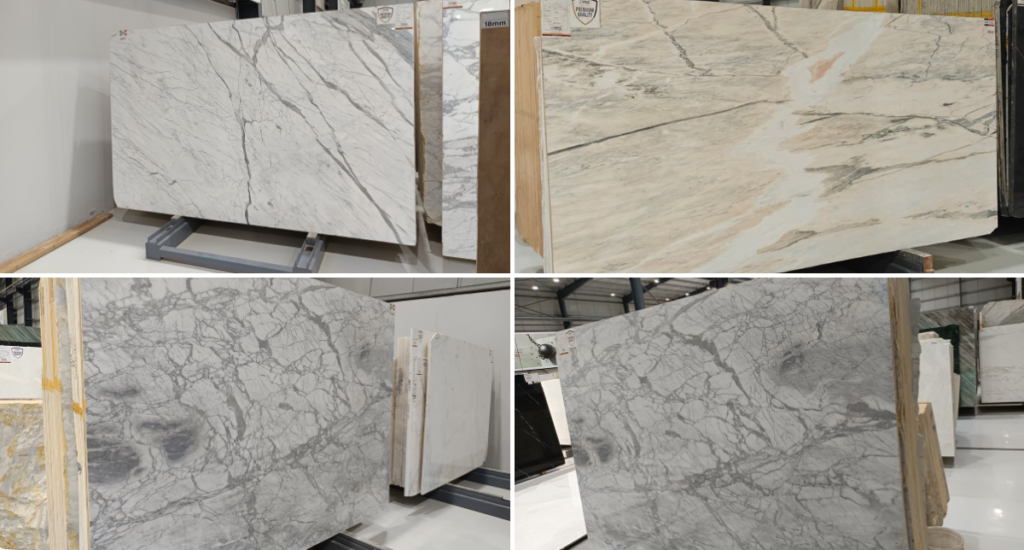
Genuine Italian marble is natural stone quarried from specific regions of Italy — primarily the Apuan Alps in Tuscany, which includes the famous quarry towns of Carrara, Calacatta, and Statuario. It is composed primarily of calcium carbonate (CaCO₃), formed over millions of years of geological compression.
What makes it irreplaceable is a combination of factors no factory can reproduce — unique organic veining, natural translucency, mineral density, and the cool temperature it holds to the touch.
The stakes of getting it wrong are significant:
- Statuario marble costs 3 to 5 times more than Carrara marble — fakes are priced as premium
- Calacatta Gold runs ₹1,200 to ₹3,500 per sq ft — counterfeits cost a fraction
- Genuine Italian marble increases in character and value over decades — imitations degrade
How Do I Know If My Marble Is Genuine Italian? 9 Tests
Test 1 — Check the Veining Pattern
The single most reliable visual test is studying the veins. Genuine Italian marble has free-flowing, non-repeating, completely organic veining. No two slabs from a natural quarry are identical — each is a geological fingerprint.
Imitations — whether printed porcelain, engineered quartz, or composite stone — always show one or more of the following giveaways:
- Veins that repeat identically across multiple tiles or slabs
- Perfectly symmetrical or mirrored patterns
- Unnaturally straight or uniformly spaced lines
- Colours that appear digitally printed rather than organically formed
What genuine Italian marble looks like: Mild blue, gold, or grey veins running irregularly across a cream or white base. Varying thickness within a single vein. Occasional crystal pockets or subtle tonal shifts in the background stone.
✅ Irregular, unique, non-repeating veins = Genuine Italian marble
Test 2 — The Touch and Temperature Test
Place your palm flat on the surface and hold it there for 5 seconds. Genuine Italian marble stays noticeably cool — this is due to its mineral density and low thermal conductivity, which draws heat away from the skin.
Chemically treated stones, porcelain tiles, and composite surfaces feel comparatively warmer. Some fake marble surfaces also feel slightly waxy, sticky, or plasticky — the result of chemical sealants or resin coatings applied to mimic the polish of natural stone.
Authentic marble has what Italian craftsmen call lucentezza naturale — a soft, breathing luminescence that is distinct from the hard, glass-like gloss of over-polished or coated surfaces.
✅ Cool, dense, non-waxy surface = Authentic Italian marble
Test 3 — The Acid Test Using Lemon Juice
This is the most chemically definitive at-home test available. Apply 2 to 3 drops of fresh lemon juice or white vinegar to a hidden area of the stone — the back of a slab, a cut edge, or a corner that will be hidden under a cabinet.
Genuine Italian marble is primarily calcium carbonate. Acid reacts with calcium carbonate immediately, producing a faint but audible and visible fizzing or effervescence. Granite, engineered quartz, ceramic tile, and most fake marble alternatives contain no calcium carbonate and will show zero reaction.
⚠️ Critical warning: Acid permanently etches polished marble. This test must only ever be performed on a completely concealed surface. It is irreversible on finished flooring, countertops, or installed tiles.
✅ Immediate fizzing = Calcium carbonate confirmed = Natural marble
Test 4 — Water Absorption Test
Drop 4 to 5 drops of plain water onto the surface and observe for 3 to 5 minutes without touching.
Genuine Italian marble is dense and naturally low in porosity. Water is absorbed slowly — you will notice the drops gradually shrinking and leaving a faintly darker ring as the stone absorbs the liquid.
Two failure modes that indicate fake or inferior stone:
- Water beads and rolls off entirely — the stone has been over-sealed with a synthetic coating, suggesting chemical treatment
- Water absorbs instantly and leaves dark marks immediately — the stone is porous and low-quality, likely not of Italian origin
✅ Slow, gradual absorption over several minutes = Dense, genuine Italian stone
Test 5 — The Sound Test
Lightly tap different areas of the slab with your knuckle or a small metal coin. Genuine Italian marble, due to its natural crystalline density, produces a clear, resonant, ringing tone — consistent across the entire surface.
Ceramic tiles, hollow-backed composites, and laminate-core products produce a noticeably duller, flatter, or hollow thud. Inconsistent sound across the same slab can also indicate internal cracking, resin filling, or composite construction.
✅ Clear, consistent ringing tone = Solid, natural stone throughout
Test 6 — The Scratch Test
Find a completely hidden area — the back of a loose slab or beneath a future fitting — and scratch it lightly with a metal key, nail, or coin.
Genuine marble leaves a faint white chalky powder — calcium carbonate residue. This is distinct from:
- A glossy streak — indicating a resin or ceramic glaze surface
- A coloured chip — revealing a ceramic body beneath a printed surface layer
- No mark at all — suggesting very hard engineered quartz or porcelain
Use this test in combination with the acid test, not as a standalone check.
⚪ White chalk residue = Calcium base confirmed — combine with other tests
Test 7 — The Light and Translucency Test
Take a strong torch or your phone flashlight and hold it directly against the edge of a tile or behind a thin slab in a darkened area.
Genuine Italian marble — particularly high-purity varieties like Calacatta and Statuario — allows light to pass through slightly, creating a warm, glowing luminescence within the stone. This translucency is a natural property of low-impurity calcium carbonate crystal and is essentially impossible to replicate in engineered or ceramic alternatives, which block light completely.
The more translucent the stone, the higher the purity and quality of the marble.
✅ Warm, inner glow when backlit = High-purity, genuine Italian marble
Test 8 — Request Provenance Certificates
Any reputable supplier of genuine Italian marble will provide written documentation covering:
- Quarry of origin (e.g. Apuan Alps, Carrara region, Tuscany, Italy)
- Specific marble variety (Bianco Carrara, Calacatta, Statuario — not just “Italian marble”)
- Quality grade and compliance with Italian stone export standards
- Lot or batch reference number traceable to a specific quarry extraction
If your supplier cannot provide this, or becomes evasive when asked, treat it as a near-certain indicator of misrepresentation. Genuine Italian marble has a traceable, documented supply chain.
✅ Written quarry provenance certificate = Verified, traceable Italian origin
Test 9 — Assess Weight and Density
Lift a loose tile or slab and judge its weight. A standard 600×600mm genuine marble tile weighs between 15 and 20 kg. Ceramic tiles, composite panels, and laminate-core products of the same dimensions weigh noticeably less.
Also check for flex. Genuine stone does not flex at all when lifted from one end. Any bend or give in the slab strongly suggests a composite, foam-core, or thin-stone-veneer product — not solid natural marble.
✅ Heavy, completely rigid, zero flex = Solid natural stone confirmed
Carrara vs Calacatta vs Statuario — How to Tell Them Apart in 2026
All three originate from the Apuan Alps in Tuscany, Italy. All three are genuine Italian marble. But they are distinct in appearance, rarity, and price — and each is frequently misrepresented in the market.
Carrara Marble
Background colour: Light grey or blue-grey white.
Veining: Fine, feathery, evenly distributed grey veins across the full slab.
Rarity: Most widely available Italian marble — produced in large volumes.
Price range (India, 2026): ₹300 to ₹900 per sq ft, approximately.
Ideal for: Flooring, bathrooms, residential interiors, classic aesthetic projects
Carrara is the most recognised Italian marble globally. It is elegant and understated — the marble of ancient Rome, Renaissance sculpture, and modern residential bathrooms alike. Its soft grey-white tone and fine, consistent veining suit both traditional and contemporary interiors.
Calacatta Marble
Background colour: Bright, pure white — the whiter the base, the rarer and more expensive
Veining: Bold, thick, dramatic veins in gold, warm brown, beige, and deep grey — fewer veins, but each one is a statement.
Rarity: Significantly less common than Carrara; commands premium prestige. Price range (India, 2026): ₹1,200 to ₹3,500 per sq ft, approximately.
Ideal for: Kitchen countertops, bathroom feature walls, luxury commercial interiors
Calacatta is what people picture when they imagine a high-end marble kitchen. Its dramatic contrast between the pure white field and the bold veining makes it one of the most visually impactful stones in the world. It is also one of the most frequently faked — always request certification.
Statuario Marble
Background colour: Brilliant, near-pure white — the brightest of the three.
Veining: Fewer veins than Carrara but dramatically bold, sweeping grey patterns with exceptional visual weight. Rarity: Rarest of the three varieties; most exclusive.
Price range (India, 2026): ₹2,500 to ₹6,000+ per sq ft approximately.
Ideal for: Sculpture, landmark architecture, ultra-luxury residential and hospitality projects
Statuario is the marble from which Michelangelo’s David was carved. Its combination of brilliant white and dramatic grey veining creates an unmatched visual authority. Due to its rarity, it is also the most frequently misrepresented — a stone labelled Statuario at a non-Statuario price should always be questioned.
Quick identification guide:
| Feature | Carrara | Calacatta | Statuario |
|---|---|---|---|
| Base colour | Grey-white | Bright white | Brilliant white |
| Veining | Fine, feathery, dense | Bold, dramatic, sparse | Bold sweeping grey |
| Gold tones | No | Yes | No |
| Rarity | Common | Uncommon | Rare |
| Price level | ₹ | ₹₹₹ | ₹₹₹₹ |
5 Red Flags That Signal Fake or Misrepresented Italian Marble
🚩 Red Flag 1 — Repeating or Mirrored Veining Two slabs with identical veining patterns cannot be natural stone. No Italian quarry produces repeating patterns. If tiles look like wallpaper, they are printed porcelain or engineered composite.
🚩 Red Flag 2 — Waxy, Warm, or Plasticky Surface Feel: Genuine marble breathes and feels cool. A surface that feels warm, waxy, sticky, or synthetic has been chemically coated — a common treatment used to disguise inferior or non-Italian stone.
🚩 Red Flag 3 — Supplier Cannot Provide Quarry Documentation: No certificate, no provenance, no lot number = no verification. Any genuine Italian marble supplier can and will provide this documentation. Refusal or evasion is a definitive red flag.
🚩 Red Flag 4 — Calacatta or Statuario Priced Like Carrara Premium Italian marble commands premium pricing for geological reasons. If Calacatta Gold is being offered at ₹400 per sq ft, it is not Calacatta Gold. Price is always a signal worth reading.
🚩 Red Flag 5 — Fails Three or More Physical Tests: No acid fizz + instant water repellence + warm to the touch + hollow sound = not genuine Italian marble. No single test is definitive, but failing three or more makes the conclusion clear.
Buyer’s Checklist — Before You Purchase Italian Marble
- Inspect the slab physically — never purchase based only on photos.
- Check that the veining is natural, irregular, and non-repeating.
- Touch the surface — it should feel cool, dense, and non-waxy.
- Perform an acid test on a hidden edge and check for fizzing.
- Conduct a water drop test and observe absorption for about 3 minutes.
- Tap different areas of the slab to ensure a consistent, clear ringing sound.
- Use a torch for backlighting and look for natural inner translucency.
- Check the weight — genuine marble should feel heavy and rigid with no flex.
- Ask for a provenance certificate mentioning the quarry and marble variety.
- Compare the quoted price with the market rate for that specific marble.
- Buy only from trusted importers who provide complete supply chain documentation.
FAQs
Q: How do I know if my marble is genuine Italian?
Q: What is the easiest test to identify real Italian marble at home?
Q: What is the difference between Carrara and Calacatta marble?
Q: Can engineered quartz be mistaken for genuine Italian marble?
Q: Will the acid test damage my marble flooring?
Q: How do I verify Italian marble when ordering online?
Q: Is Statuario marble worth the price premium?
Conclusion — Buy Genuine, Buy with Confidence
Identifying genuine Italian marble is not difficult once you know what to look for. The combination of irregular natural veining, cool dense touch, calcium carbonate acid reaction, slow water absorption, and verified provenance certification gives you near-complete certainty before spending a rupee.
The three most important rules to remember in 2026:
- No two genuine Italian marble slabs are ever identical — if they look the same, they are not natural stone
- Lemon juice fizz confirms calcium carbonate — the chemical foundation of all real marble
- A reputable supplier always has paperwork — no documentation means no verification
At RMS Stonex, every slab of Italian marble is sourced directly from certified Apuan Alps quarries with full traceability from extraction to delivery. Contact our stone specialists to verify, compare, and select your genuine Italian marble with complete confidence.